
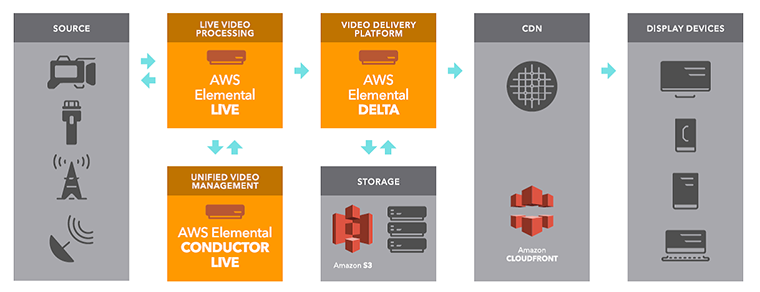
Elemental Live is a real-time video processing system that provides real-time audio and video encoding for television broadcasters and various new media platforms. The system combines the characteristics of hardware with massive parallel processing capabilities and flexible, reliable software, significantly reducing the overall cost of video compression processing.
Elemental Live offers unprecedented processing density, enabling the simultaneous processing of multiple adaptive bitrate encoding outputs, delivering the high-quality and efficient performance required for streaming live video to any device. Elemental Live can seamlessly integrate into any end-to-end real-time workflow, eliminating complex configurations and optimizing multi-screen video delivery.
Core Advantages
The Elemental video engine is designed based on NVIDIA's professional GPUs, providing massive parallel processing capabilities and offering unique advantages in compute-intensive video compression and image enhancement tasks. Because Elemental's core technology is software-based, it possesses a high degree of flexibility and allows for rapid innovation. This core technology is a widely used product that meets diverse market demands, from consumer desktops to enterprise-level needs of some of the world's most recognized media brands, including CBS, Comcast, and Disney.
Elemental's video engine offers a wide range of services, including faster encoding/transcoding, higher quality image processing, increased throughput, and optimal utilization of system resources. For HD, Elemental has significant advantages in enterprise-level video processing and broadcast-quality video using a massively parallel architecture. Parallel processing provides greater efficiency, density, and throughput, thereby reducing space, energy, and cooling requirements in video centers. Our GPU encoding software can operate on consumer-grade hardware, eliminating the reliance on expensive dedicated hardware. Finally, the massively parallel architecture makes it easier to handle the massive computational demands of high-definition video.
Elemental is dedicated to designing video processing software that runs on off-the-shelf hardware to deliver a flawless media experience. We collaborate with globally renowned technology vendors, such as NVIDIA's Fermi GPU and Intel's Sandy Bridge hybrid CPU, which allows us to customize solutions for various hardware platforms.
Typically, we first develop consumer product lines for new hardware platforms, and as the technology matures, we integrate them into our enterprise products. Based on this approach, Elemental consistently stays at the forefront of the innovation curve. We have established strategic partnerships with top hardware manufacturers such as NVIDIA and Intel.
HEVC/H.265 Encoding
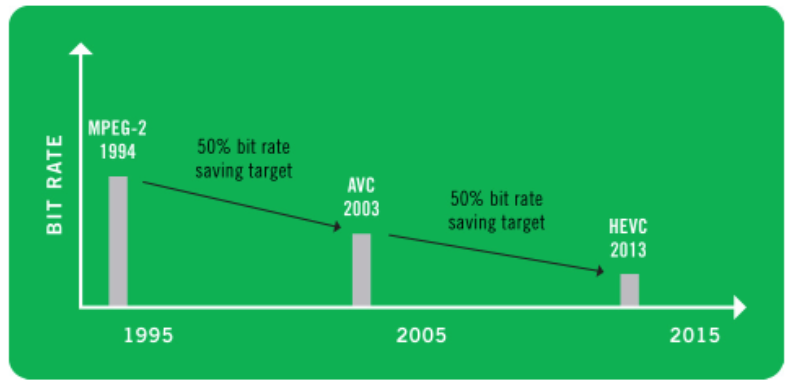
Elemental's video encoding solutions provide support for HEVC/H.265 (High Efficiency Video Coding). Given the significant network capacity consumed by video transmission, the structure of HEVC/H.265 offers approximately a 30% to 50% bandwidth efficiency gain compared to the AVC/H.264 standard. These improvements in efficiency have a more positive impact on the video industry, including:
- More channels are deployed through satellite, cable, and IPTV networks.
- Reduce management and non-management costs of video distribution.
- Expand the bandwidth limitations for mobile and IPTV operators.
- Improve the QOE services of OTT to complement traditional broadcast delivery.
HEVC/H.265 is an ideal encoding method for GPUs. The computational complexity of HEVC/H.265 encoding is up to 10 times higher than that of H.264, making it very suitable for large-scale parallel GPU architectures. Due to the need to encode each macroblock in 500 different ways, the demanding processing requirements of H.265 will cause many existing hardware platforms to hit performance bottlenecks. Elemental's software upgrade approach can integrate new compression technologies much more quickly than products based on fixed hardware encoding and decoding, facilitating the transition of traditional infrastructures supporting MPEG-2 and H.264 to HEVC/H.265.
System Features
- This system supports converting the same video source into multiple formats and bitrates, including HD, SD, and LD. The output bitrates can be configured for complete GOP alignment.
- Configurable and manageable templates for various common transcoding rules are available for user selection. Users can customize transcoding templates and import/export template settings.
- Supports third-party system calls for transcoding tasks and local initiation of transcoding tasks.
- The transcoding system offers excellent image compression quality.
- Supports logo overlay, with adjustable logo position. It also supports adding a black border and cropping the black border.
- Supports multiple audio tracks and subtitle functions.
- Supports adjustable contrast and brightness.
- Supports noise reduction filters.
- Supports audio passthrough, audio gain adjustment, audio delay adjustment, and volume gain adjustment.
- Supports multi-task priority processing.
- Equipped with a centralized operating interface, the system management and maintenance can be carried out for daily upkeep without relying on third-party devices.
- This system supports smooth software upgrades.
- The system architecture is clear and facilitates management.


System Parameters
Physical Parameters:
Dimensions: 19 in x 1.75 in x 33.25 in
(Width x Height x Length) 48.26 cm x 4.45 cm x 84.46 cm
Weight: 18 kg (net weight)
25Kilograms (including packaging)
Electrical Parameters:
Power Consumption 1250W (maximum)
Cooling capacity 1.25 kW/h (maximum)
Line Frequency 50 - 60 Hz
Input Voltage 100 - 110 VAC; 110 - 120 VAC; 120 - 127 VAC; 200 - 240 VAC
Working Environment:
Operating Environment 10 °C to 35 °C (50 °F to 95 °F)
8% to 90% RH (Non-condensing
Storage Environment -40 °C to 70 °C (-40 °F to 158 °F)
5% to 95% RH (Non-condensing
Noise Level 68 dB (maximum)
Electromagnetic Standards EN 55024 and CISPR 24
Safety Standards CSA/EN/IEC/UL 60950-1 Compliant, UL or CSA Listed, CE Mark
System Specifications:
System Management IPMI 2.0
Storage Capacity 1TB Redundant Storage
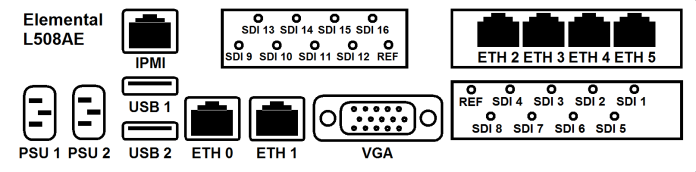
Physical Interface 6x 1 GbE RJ45 Port; 16x HD-SDI Port
Input Supported Formats
Real-time input
- Single and multi-program streams transmitted based on UDP/RTP protocol
- SDI (Uncompressed, options available: SD-SDI, HD-SDI, 3G-SDI, Quad 3G-SDI (4K)
- Network inputs for protocol encapsulation: HLS, RTMP, etc.
- Video encoding format:
- H.264Up to 4:2:2
- H.265Up to 4:2:2
- MPEG-2
- VC-1
- Apple ProRes ®
- RAW
- Audio encoding format:
- AC-3(Dolby Digital)
- EAC-3(Dolby Digital Plus)
- Dolby E
- AAC
- MPEG
File Input
-MXF (AS-02, OP-1a-c, OP-2a-c, OP-3c), QuickTime, MPEG-4
- Packaging files: HLS, Adobe Flash
- Discrete audio and subtitle input
- Video Encoding Formats:
• Apple ® ProRes, Apple ® ProRes XQ
- AVC Intra 50/100
- DivX/Xvid
- DV/DVCPRO HD
- H.261-H.265
- JPEG-2000
- MPEG-1/2/4 part
- VC-1
- Panasonic P2
- DV25, DV50
- DNxHD
- MJPEG
- Sony XDCam
- Sony XDCam MPEG-4 Proxy
- Audio encoding format:
• AC-3 (Dolby Digital)
• EAC-3 (Dolby Digital Plus)
- Dolby E
- MPEG-1 Layer IIMPEG-1 L3, MPEG-2 L2
- WMA/2
- PCM
- AIFF
- AAC
File Input Function
- Separate audio and video files
- Audio delay offset, PID tracking, language tracking, track selection.
- MPEG-2Unboxing
- Source file cutting
- Quick Search
- Merge multiple sources into a single output.
- Channel selection for multi-track input
- Pure audio input
- Supports Amazon S3
- Static image overlay for each input
Output encoding format
Video
- H.264 (Baseline, Main, High up to 4:2:2), 4:2:2 High Profile Intra 10 bit *
- H.265 (Main, Main10 up to 4:2:2) *
- VC-1 (Simple, Main, Advanced)
- Frame capture to JPEG (thumbnail creation)
- MPEG-2
- Uncompressed
- Apple® ProRes (up to 4:2:2 10 bit)
Audio
- AAC-LC, AAC-HEV1, AAC-HEV2 (MPEG-2, MPEG-4, LATM/LOAS)
- WMA2
- Uncompressed WAV, AIFF
- AC-3 (Dolby Digital) *, AC-3 passthrough
- EAC-3 (Dolby Digital Plus) *, EAC-3 passthrough
- Dolby E (passthrough)
- DTS Express *
- MPEG-1 L2
- Audio only support
Output packaging format
Real-time output
- Adobe Media Server (F4F)
- Adobe HTTP Dynamic Streaming (HDS)
- Microsoft Smooth Streaming (ISMV)
- Apple HTTP Adaptive Streaming (HLS)
- MPEG-2 Part 1, Systems, CableLabs compliant (EBIF passthrough, EBP, PSI, RAI segmentation marker) (MPEG-TS)
- MPEG DASH (ISOBMFF)
- Adobe RTMP Streaming
- Real Time Streaming Protocol / Real Time Protocol (RTSP/RTP)
- Single and Multiple Program Transport Streams (SPTS, MPTS) over UDP/IP and RTP/IP with FEC
File Output
- Microsoft Windows Media (WMV/ASF)
- Apple QuickTime and ProRes (MOV)
- Ultraviolet (UVU)
- Sony XDCAM MXF (XDCAM)
- RAW YUV or RGB formats (Uncompressed)
- Adobe Media Server (F4V)
- MPEG-4 Part 10 (MP4)
System Control
Conventional Control Interface: HTML page control based on Ethernet control interface.
Automation Control: REST XML API
Integrated CDN Support: Basic PUT, WebDav, and Akamai
Monitoring: System resource and operational statistics monitoring
User Authentication: Supports multi-user login with hierarchical levels, Amazon S3 public and private keys, and IAM role support.
Network Management (SNMP): SNMP version 2c
Real-time actionable content: - Stop, pause, and resume streaming tasks and archived files.
-Audio gain adjustment, real-time volume control
-Video and audio preview